How to register an Estonian OÜ company online in the e-Business Register, step by step
Found an Estonian private limited company (OÜ) yourself in the e-Business Register: what you need, every step with screenshots, how much capital to choose, and the 265 euro state fee. No agent needed.
Law as of 14 Oct 2026. General information, not advice for your situation.
Part of the guide: Founding an OÜ in Estonia: capital, articles, name, fees and first steps
You can found an Estonian private limited company (OÜ) yourself, online, in about an hour. The only fee is the state fee of 265 euros. You do not need a formation agent.
Oscar does not found companies. This page shows you every step of the state portal instead, with screenshots we took on 14.10.2026. The example company, "Kaktus Näidis OÜ", was never submitted, and personal data is greyed out.
In short
- Every founder and board member needs an Estonian ID card, an e-Residency card, Smart-ID or Mobile-ID.
- You fill in 11 steps, everyone signs, the board confirms the capital is paid, you pay the fee, and the application goes out.
- The registrar usually decides by the next working day.
Before you start
- A digital ID. Every founder and board member logs in and signs with an Estonian ID card, an e-Residency card, Smart-ID or Mobile-ID. Not Estonian? Become an e-resident first.
- A name, and one or two spare ones.
- An address in Estonia. If you live abroad, a legal address service gives you one. See e-Residency, address and contact person.
- An e-mail address you can open. It is public.
- The personal codes of the people involved.
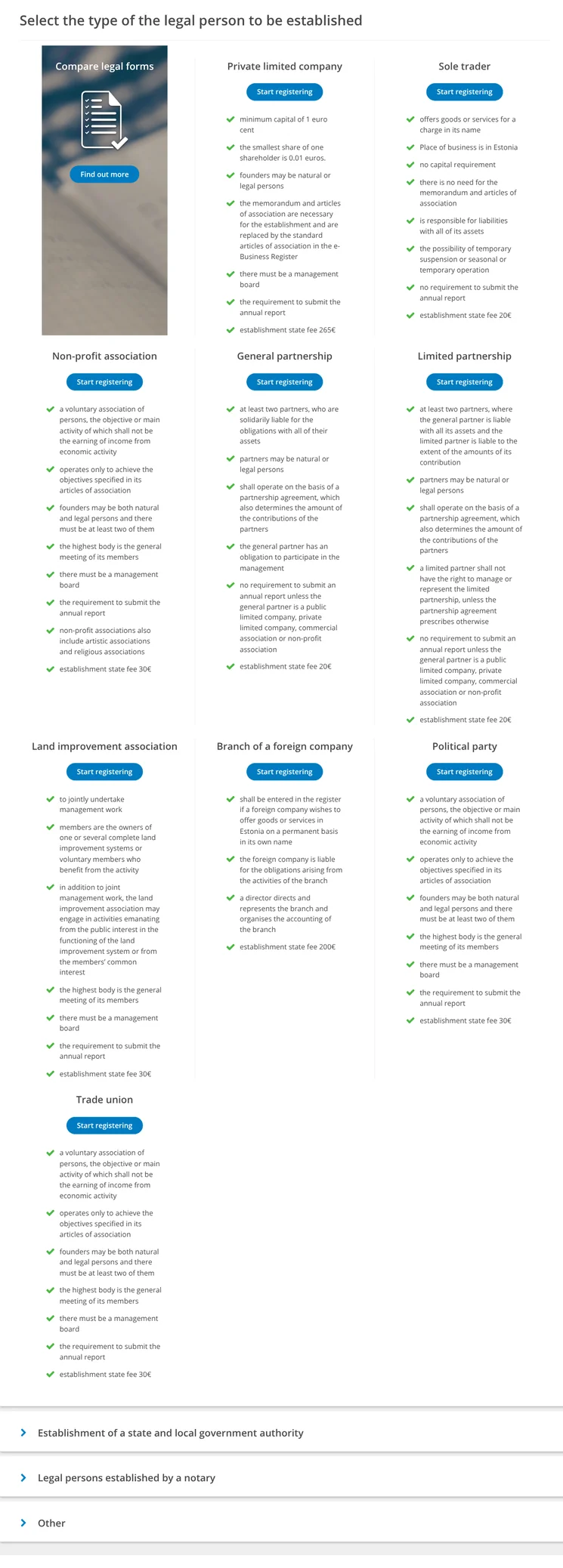
Log in at ariregister.rik.ee, open Establishment, and choose Private limited company.
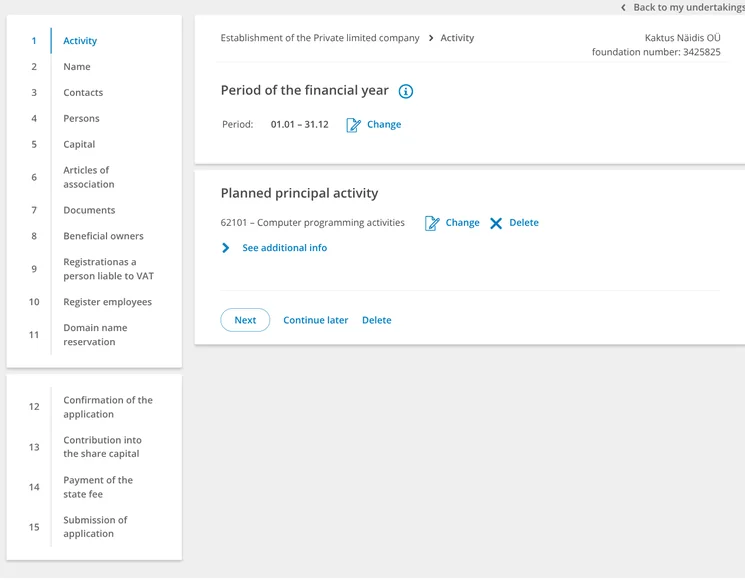
Step 1: the activity
Pick the main activity from the tree, down to a five-digit code, and press Select. Keep the calendar year as the financial year unless you have a reason not to.
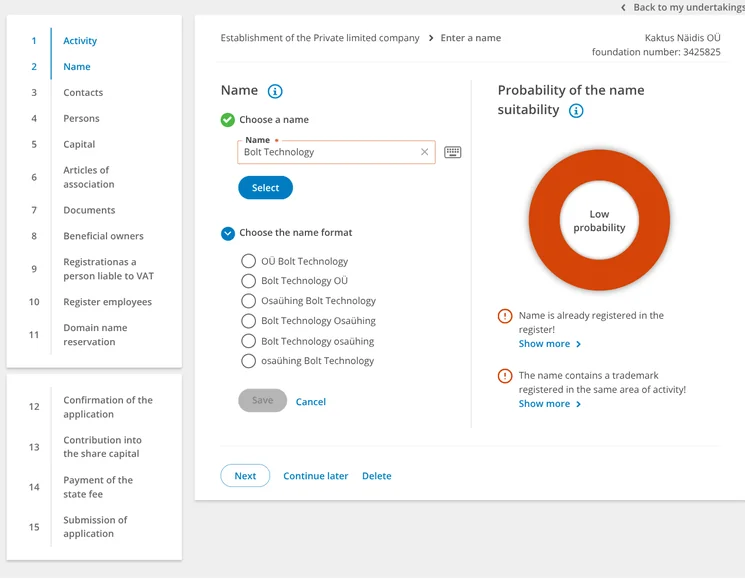
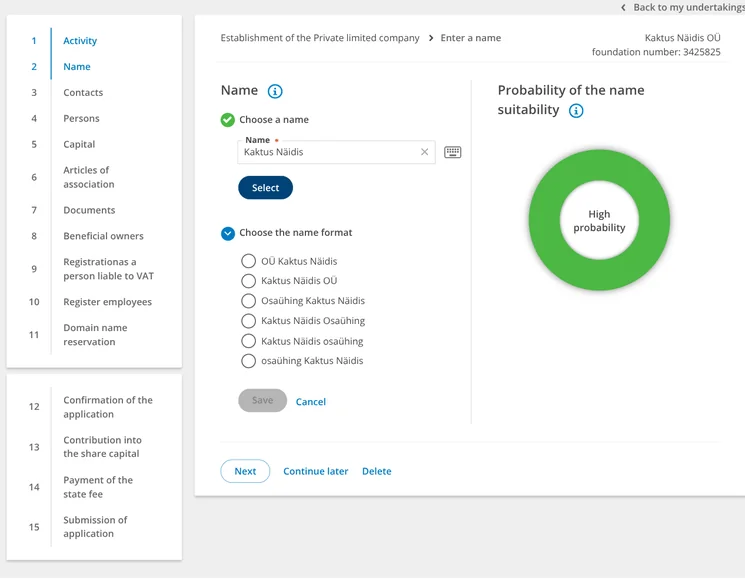
Step 2: the name
Type the name without "OÜ" and press Select. The portal compares it with existing companies and trademarks. Aim for "High probability", then choose where "OÜ" goes.
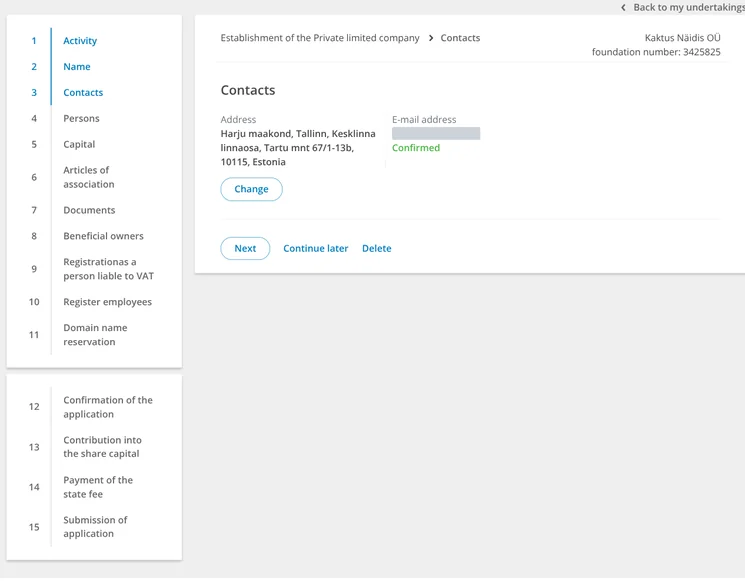
Step 3: the address and e-mail
Search the address, pick it, and add the postal code. Enter the company e-mail. The portal sends it a confirmation link, and you cannot submit until you click it.
Step 4: the people
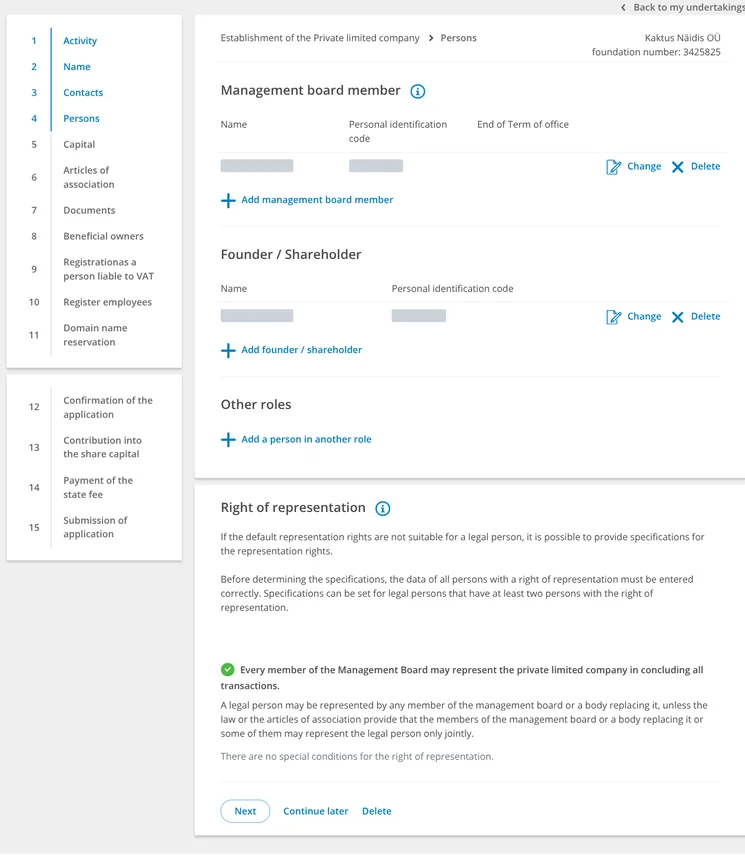
Add at least one board member (the person who runs the company) and one founder (who becomes the shareholder). Often it is the same person. The portal fills in the name from the personal code. Board members are public in the register.
Step 5: the share capital
Enter how much each founder puts in. The legal minimum is one cent.
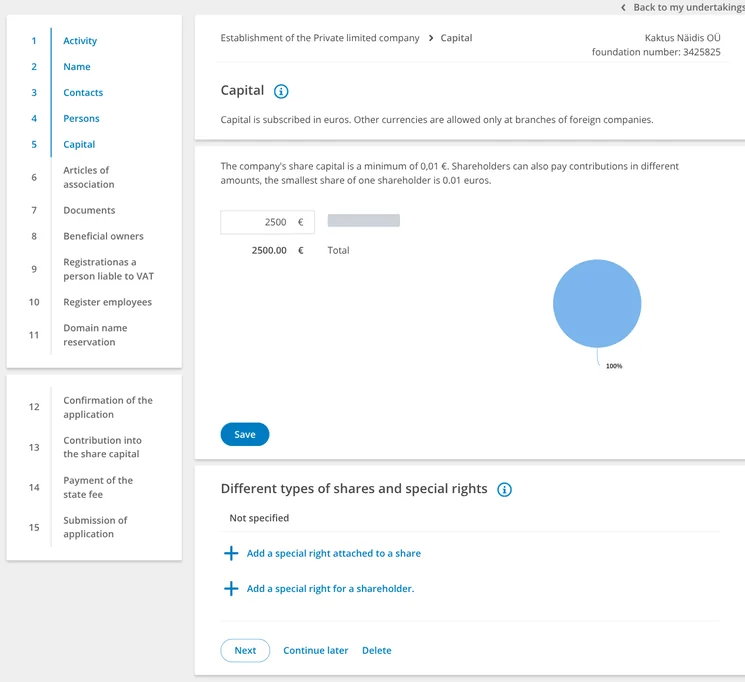
How much should you choose? One cent is allowed, but keep two things in mind:
- Below 2,500 euros, you can still owe up to 2,500 euros. If the company goes bankrupt with no money left, the court-appointed trustee can ask the shareholders to pay their fee, up to the gap between the capital and 2,500 euros (Bankruptcy Act § 29). You do not answer for the company's other debts.
- A tiny capital looks weak to banks, landlords and customers, who can see it in the register.
Our advice: choose 2,500 euros or more if you want the company to look trustworthy. For a one-person freelance company, less is fine.
You pay the capital in money, in full, before the application goes out. Founding without paying it in is no longer possible (Commercial Code § 140). Up to 50,000 euros you need no bank certificate: the board confirms the payment in the application. Never confirm money you have not paid.
Step 6: the articles of association
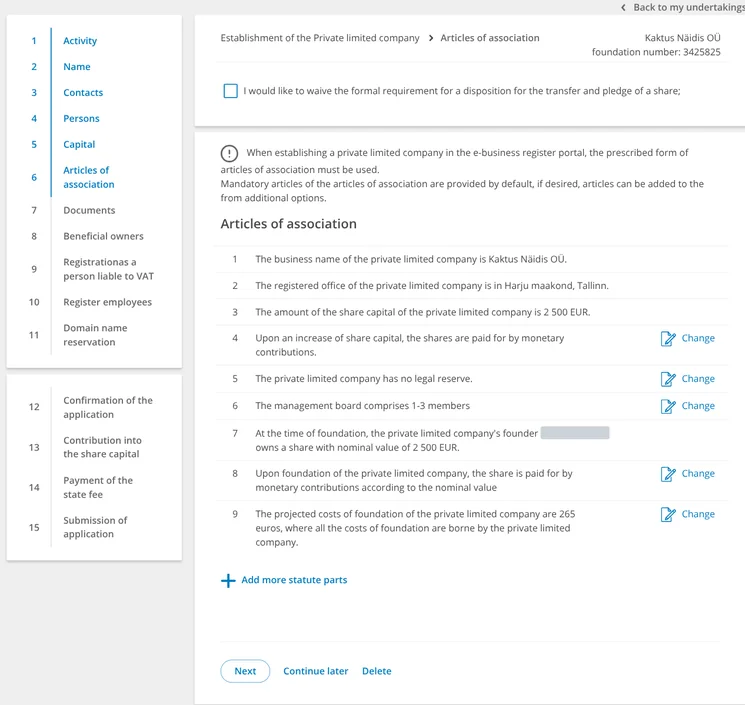
The portal uses standard articles and fills most of them in. You choose a few points: how a later capital increase is paid, whether there is a legal reserve, the number of board members, and who bears the founding costs. The defaults suit most small companies. Need special share classes or transfer rules? That needs a notary: see articles of association.
Steps 7 and 8: documents and beneficial owners
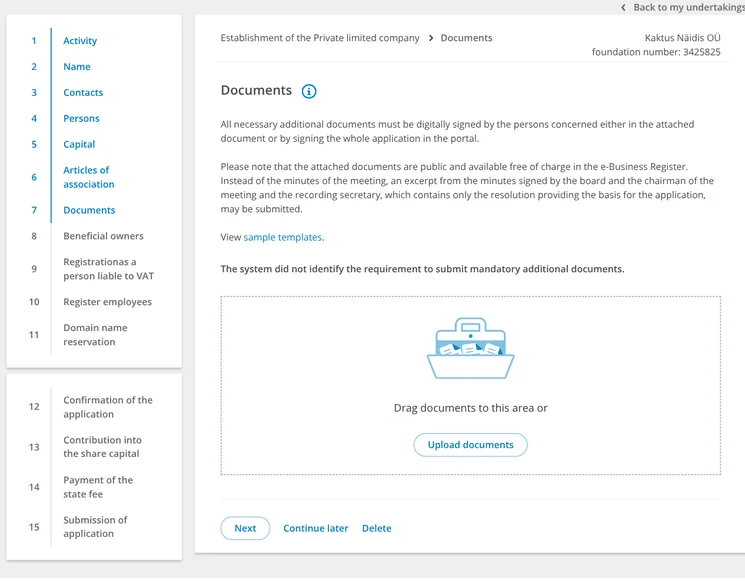
A simple OÜ needs no extra documents. Anything you upload is public.
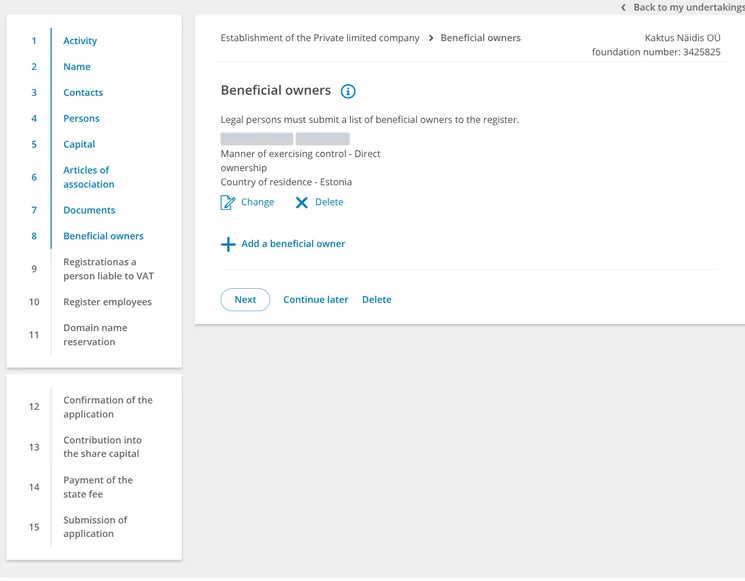
Then confirm the beneficial owners: the people who really own or control the company. The portal suggests the shareholders. Choose their country of residence and "Direct ownership".
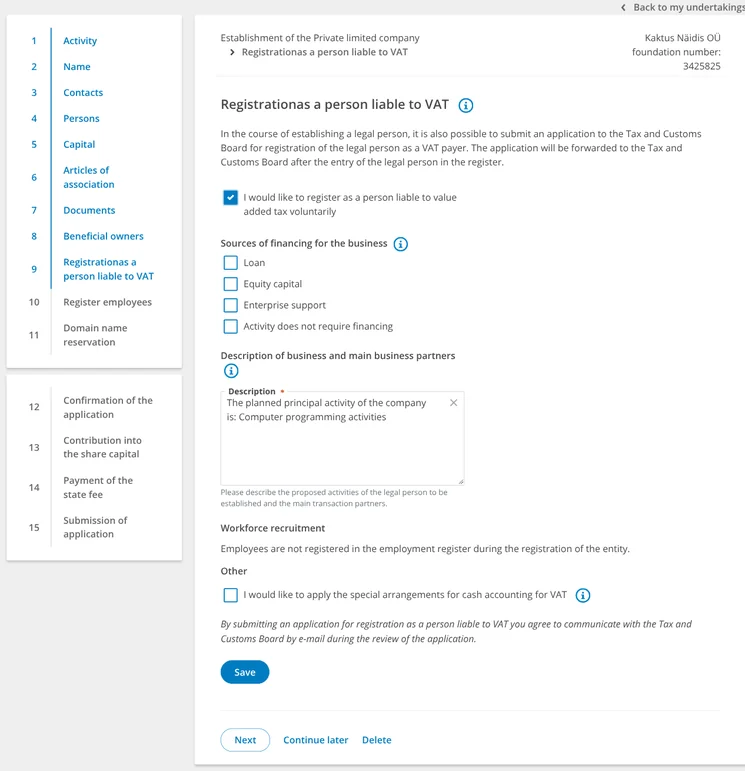
Steps 9 to 11: VAT, employees and .ee domains
All three are optional, and you can do each one later:
- VAT: register voluntarily. It is compulsory only above 40,000 euros of sales a year, see VAT registration.
- Employees: add your first employees to the employment register.
- .ee domains: reserve up to 20 domain names for 7 days after registration.
Step 12: check and sign
The portal shows the whole application and the generated documents. Check every line, then press Sign. Every person in the application signs, each with their own digital ID, from their own dashboard. If you go back and change something, all signatures are lost.
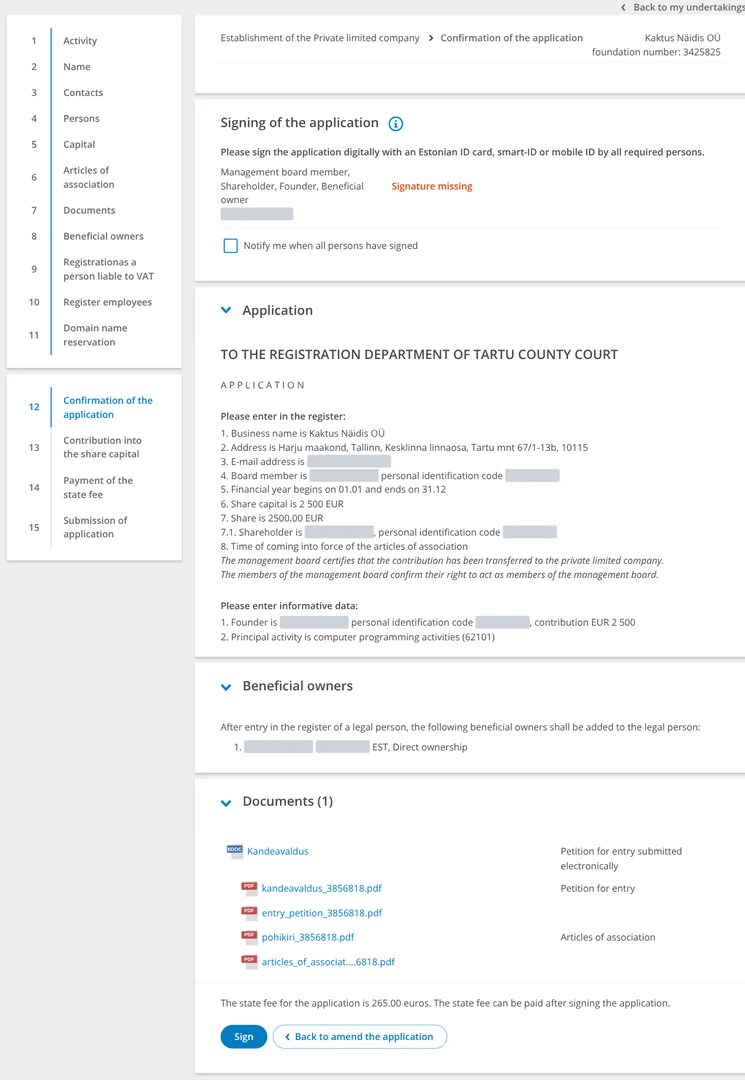
We never paid or submitted our example.
Steps 13 to 15: confirm the capital, pay the fee, submit
Step 13 asks the board members to confirm that the share capital has been paid to the company. Up to 50,000 euros of capital, this confirmation is all the portal needs: tick the box and press Confirm. No bank statement is asked for. Above 50,000 euros, you pay the capital into the court's deposit account instead, by bank link (Coop, LHV, Luminor, SEB or Swedbank) or by bank transfer.
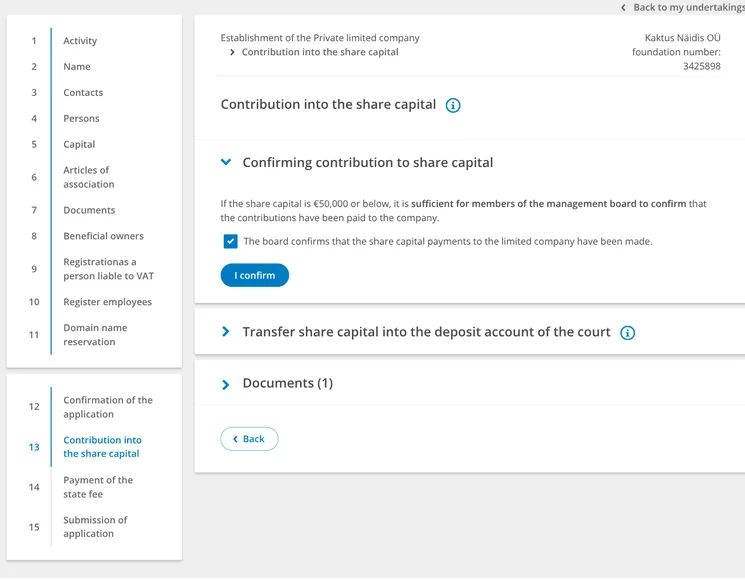
Step 14 is the state fee, paid by bank link in the portal or by bank transfer. Step 15 submits the application. By default it goes out automatically once the fee arrives.
| What | Cost |
|---|---|
| State fee, online | 265 euros |
| State fee at a notary (for custom articles) | 200 euros, plus the notary's fee |
| Share capital | Your choice; it stays the company's money |
| Legal address service, if you live abroad | The provider's price |
After you submit
The registrar decides at the latest on the next working day and tells you by e-mail. Your company then has a registry code. Next: open a business bank account and set up your bookkeeping, see the first weeks after registration. Once the company is registered, Oscar can keep its books.
Sources
- e-Business Register portal
- Centre of Registers and Information Systems: establishment of a private limited company
- Centre of Registers and Information Systems: signing an application
- Commercial Code § 136
- Commercial Code § 140
- Commercial Code § 141
- Commercial Code § 144
- Commercial Code § 146
- Commercial Code § 148
- Commercial Code § 520
- Bankruptcy Act § 29
- Commercial Register Act § 24
- Commercial Register Act § 42
- Commercial Register Act § 43
- State Fees Act § 62
Related pages
- Founding an OÜ in Estonia: capital, articles, name, fees and first steps
How to found an Estonian private limited company (OÜ): the share capital and how it is paid in, the articles of association, the state fees online and at a notary, the business name, the EMTAK activity codes and licences, a company as founder, holding or direct ownership, the first weeks after registration, and the risks of a shelf company.
- e-Residency and your Estonian company: what it gives, the legal address and the contact person
What Estonian e-Residency lets a foreign founder do and what it does not give, what happens when the card expires, when an OÜ needs a contact person, a legal address abroad or at a virtual office, how documents are served by e-mail, how to choose a service provider, and why e-Residency does not make you tax resident.
- VAT registration in Estonia
When an Estonian company must or may register for VAT, the 40 000 euro threshold, limited registration, deregistration and VAT groups.
- OÜ (osaühing)
What an OÜ (osaühing) is: the Estonian private limited company, with shares, limited liability, a share capital from one cent and a management board.
Reviewed on 14 Oct 2026. Law as of 14 Oct 2026. General information, not advice for your situation.